
For anyone considering studying abroad in the future, migrating, or even working overseas in the upcoming 2026, the IELTS test is one of the best ways to demonstrate one’s English skills. However, the IELTS test is undergoing a number of changes. Here are the IELTS 2026 changes anyone planning on taking the test should take into account.
First and foremost, the IELTS test is going to transition from being a paper-based examination to a computer-based test and students should be extra careful to prepare for their computer-based IELTS examination (specifically the IELTS writing test) in order to get the desired IELTS band score.
IELTS examinees can learn more about the IELTS exam below, as well as how they can utilise the IELTS 2026 changes, test formats, and preparation tips before taking their test
What Is IELTS?
The IELTS, or International English Language Testing System, is a test that is often required by higher education institutions, professional bodies, employers, and government agencies for immigration, study, training, or employment purposes.
There are two types of IELTS tests: IELTS Academic and IELTS General Training. While the Listening and Speaking tests are the same across the two tests, the Reading and Writing tests differ. The IELTS Academic is designed for students wishing to pursue undergraduate, postgraduate, or professional qualifications, while the IELTS General Training is designed for students wishing to undertake non-degree level studies or immigrate into an English-speaking country.
The IELTS test requirements differ according to which institution, company, or government agency one wishes to join or move to. As such, it is always important for examinees to do their homework and determine which IELTS test requirements they would need to meet prior to taking their test.
IELTS 2026 Changes
Below are the IELTS 2026 changes that examinees must be aware of:
1. The IELTS Is Ending Paper-Based Testing
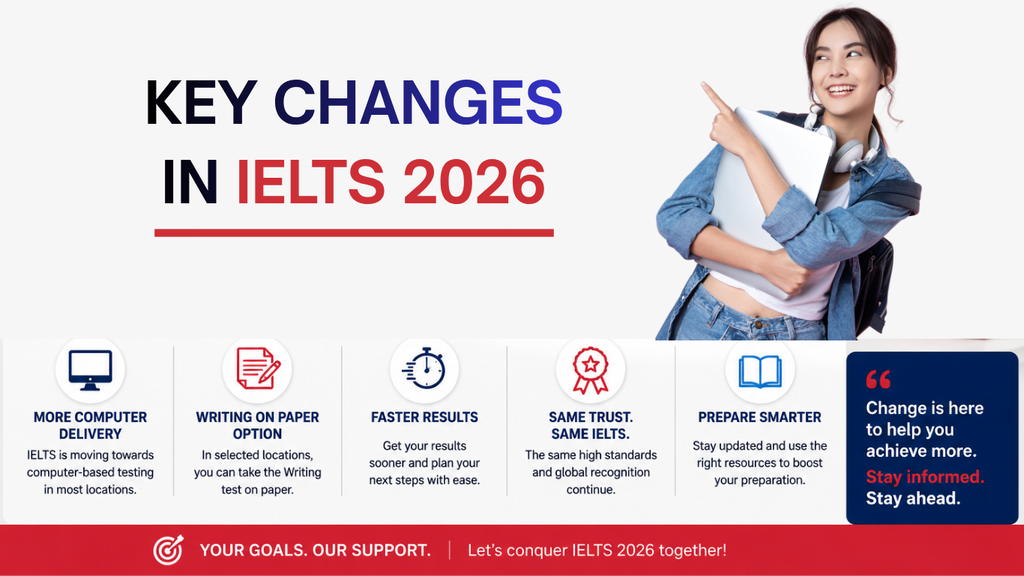
The first IELTS 2026 change to take note of is that the IELTS is ending paper-based testing. From the middle of 2026, IELTS tests will be computer-based. According to the IELTS, “writing on paper” options will continue to be available in select markets for the IELTS examinations, as per the following:
This means that for students hoping to get a desirable IELTS band score, especially in the IELTS Writing test, they would need to prepare for these changes to the IELTS test. Computer-based IELTS tests require extra preparation for test-takers and students should utilise computer-based IELTS practice tests to prepare by getting accustomed to:
• Reading on a screen
• Typing
• Navigating the test
• Listening to the computer
• Time management
• Reviewing and editing
Although the prospect of computer-based IELTS tests might seem intimidating to students who are used to the old paper-based IELTS exams, these modifications should come as second nature to test takers with sufficient preparation.
2. There Will Be an Option to “Write on Paper” for Certain IELTS Tests
Another IELTS 2026 change to take note of is that there will be a “writing on paper” option for certain IELTS tests.
What this change entails is that examinees will be able to take “Listening” and “Reading” tests on a computer and “Writing” tests on paper. In other words, candidates will be able to complete all IELTS Writing questions on an IELTS Writing Answer Sheet using a pen. This change will be piloted across certain markets.
It is also important that examinees understand that the content of the tests, scoring criteria, and time allocated per section of the IELTS test would remain the same, with the exception that students taking the Writing section on paper would need to hand-write their responses instead of typing. According to the IELTS test makers, students would need to ensure that their handwriting is legible, as the scores for the writing on paper tests were comparable to traditional paper-based tests. As such, if students prefer to hand-write their IELTS Writing answers, then this change is ideal for them!
3. The Skills Assessed and Score Interpretation Are Remaining the Same
According to the IELTS, the skills assessed and score interpretation are remaining the same in IELTS 2026. This means that if a student has experience with the old paper-based IELTS tests, then they should not be overwhelmed by the computer-based IELTS tests because both versions of the examination assess the same skills. In other words, both versions of the IELTS tests utilise the same scoring criteria. The IELTS tests will continue to assess candidates’ language skills in Listening, Reading, Writing, and Speaking.
For example, candidates taking the IELTS Academic test will have 30 minutes for the Listening test, 60 minutes for the Reading test, 60 minutes for the Writing test, and 11-14 minutes for the Speaking test. As such, students should refrain from thinking that computer-based tests are easier or more difficult than paper-based examinations because both versions of the test are just as challenging. Now that we understand the skills assessed by the IELTS tests, let us discuss what examinees need to know about the academic IELTS tests.
What You Need To Know About IELTS Academic
For students who wish to pursue an undergraduate, postgraduate, or professional degree, it is mandatory for them to take the IELTS Academic test. The IELTS Academic Reading tests require examinees to read academic texts while the IELTS Academic Writing tests require test-takers to write two essays within 60 minutes.
The first essay, also referred to as Task 1, requires students to describe a graph/table/chart/diagram within at least 150 words.
The second essay, on the other hand, requires examinees to discuss a point of view, opinion, or a problem within at least 250 words.
As such, students should ensure that they have sufficient practice with IELTS Writing to achieve a desirable IELTS band score within the IELTS Academic writing test.
Why IELTS Writing Practice Is Important
The IELTS Writing test is often considered to be the most challenging segment of the IELTS examination because IELTS Writing tasks require test takers to demonstrate a wide range of skills, including vocabulary and grammatical range, adherence to word limits, organisational and time-management skills, and understanding of the IELTS Writing task requirements. IELTS Writing tasks also require students to showcase problem-solving skills, and critical-thinking skills.
For example, examinees will need to understand what information they need to report when describing a graph/chart (IELTS Writing Task 1) and provide solutions for a problem (IELTS Writing Task 2). In the IELTS Writing Task 2, examinees may be required to discuss a point of view or opinion.
An effective IELTS training programme will allow students to develop skills to pass the IELTS Writing test. Students should also identify their IELTS Writing weaknesses and work on overcoming them. When working with an IELTS trainer, students should ask the trainer to assess their essays to discover their weaknesses.
How Should You Prepare for IELTS In 2026?
Now that we understand what skills are assessed in the IELTS tests, let us discuss how one should prepare for the IELTS in 2026.
1. Choose The Right IELTS Preparation Program
The first step when preparing for the IELTS examination is to choose the right preparation programme. Examinees should decide which IELTS test they want to take and the IELTS score they want to achieve. Those who have identified the IELTS test they want to take and the IELTS band score they want to achieve should determine the best IELTS training programme that they can utilise to prepare for the examination. It is important that examinees choose a good IELTS training programme because a good IELTS trainer will be able to teach them the skills they need to pass the IELTS tests, not just IELTS-specific content.
2. Practice With Computer-Based Tests
The drastic IELTS 2026 change of the transition from paper-based tests to computer-based tests means that examinees should practice with computer-based tests to ensure they familiarise themselves with the new test format. Students should not procrastinate and begin practicing with the computer-based IELTS tests early so they can display their language proficiency during the examination. Moreover, students who practice with computer-based tests can improve their typing skills and develop the ability to read long pieces of text on a screen.
3. Do Regular IELTS Writing Practice
IELTS writing practice is essential for students who wish to achieve a desirable IELTS band score in the IELTS Writing tests. Therefore, students should allocate enough time to IELTS writing practice so that they can develop the skills needed to write effective essays within the word limit. In addition, students should review their IELTS writing essays to identify their weaknesses and work on overcoming them. For instance, students should work with their IELTS Writing coach on developing skills in areas where they are lacking.
4. Learn New Vocabulary
It is necessary for IELTS examinees to learn new vocabulary to improve their language proficiency, but it is always better to learn new words in context, rather than studying vocabulary lists. For instance, students wishing to take the IELTS test for migration purposes or higher education purposes should learn academic vocabulary related to education, technology, the environment, health, employment, and other relevant topics. However, it is important not to use complex words incorrectly in the IELTS Speaking and Writing tests because it can negatively affect one’s score in these segments of the IELTS test.
5. Improve Your IELTS Speaking Skills
The IELTS Speaking test is a one-to-one conversation with the IELTS examiner, and test takers need to demonstrate their language proficiency to the IELTS examiner. Candidates need to showcase their vocabulary and utilise a variety of grammatical structures appropriately and speak clearly and confidently during the IELTS Speaking test. There are a number of methods that one can utilise to improve their IELTS Speaking skills, for instance, recording practice tests to determine their weaknesses. Moreover, students should work on overcoming their weaknesses if their IELTS Speaking coach discovers any.
The IELTS Speaking test consists of three parts.
In Part 1, the IELTS examiner will ask test takers general questions about familiar topics such as their studies, work, and interests. In Part 2, examinees will be asked to speak about a particular topic for 1-2 minutes. Lastly, Part 3 requires test takers to have an in-depth discussion about the topics introduced in Part 2.
What About One-skill Retake?
One important thing to note about the IELTS examination is the One-skill Retake. If a student is not satisfied with their IELTS score, they should consider utilising the One-skill Retake option. In other words, if a student is not satisfied with their overall IELTS score, they can contact their local IELTS test centre and resubmit the skills that they are not satisfied with to enhance their overall IELTS score. According to the IELTS, students need to complete the one-skill retake within 60 days of their original test date.
Not all organisations accept the one-skill IELTS retake, therefore, it is always necessary for students to be aware of their options prior to taking the IELTS test.
Are IELTS Score Requirements Changing?
The majority of the IELTS 2026 changes that have been announced entail changes to the IELTS test format rather than score requirements. It is important that candidates understand that IELTS score requirements differ according to the institution, company, or government agency that one wishes to apply to. It should also be noted that IELTS score requirements can vary from country to country. Therefore, it is vital that examinees conduct research on the IELTS score requirements of their target organisations, companies, and government agencies and set realistic IELTS band score goals.
Final Thoughts
The IELTS tests will undergo a number of changes in 2026, such as transitioning from paper-based tests to computer-based tests and introducing a new “writing on paper” option. Nonetheless, the skills assessed during the IELTS tests and score interpretation will remain the same. If one wishes to take the IELTS Academic test, then it is important that one has the required skills to take the test, particularly if one aspires to achieve a high IELTS band score. Therefore, students should utilise the trusted training centre to discover the skills that they need to improve and develop their test-taking skills. Most importantly, students should practice for the IELTS tests, especially the computer-based tests, to achieve a desirable score in the IELTS examination in 2026.
Planning to take the IELTS examination in 2026? Then, take the IELTS test preparation course and prepare!
Frequently Asked Questions (FAQs)
1. What are the major IELTS changes in 2026?
The biggest change is the transition toward computer-delivered IELTS. Traditional paper-based testing is being phased out globally, while some markets are introducing a Writing on Paper option. The skills assessed and scoring system remain unchanged.
2. Is IELTS Academic changing in 2026?
The IELTS Academic test continues to assess Listening, Reading, Writing, and Speaking. The main change is how the test is delivered rather than what is assessed.
3. Is IELTS becoming completely computer-based?
IELTS is moving toward computer delivery. However, the Writing on Paper option is being introduced in selected markets, so availability may depend on your location and test centre.
4. Will the IELTS Writing section change in 2026?
The IELTS Writing tasks and assessment criteria remain the same. Candidates may have the option to write their answers by hand in selected locations, while other candidates will complete the section on a computer.
5. Is computer-based IELTS easier than paper-based IELTS?
Neither format is officially considered easier. The test assesses the same English-language skills. Your performance will depend on your familiarity with the format, so practising with the format you will take is important.
6. How can I prepare for IELTS in 2026?
Start with a structured IELTS preparation course that covers Listening, Reading, Writing, and Speaking. Include regular mock tests and practise using a computer if your test will be computer-delivered.
7. How long should I prepare for IELTS?
The ideal preparation period depends on your current English level and target band score. Many candidates benefit from several weeks of consistent IELTS training, while those who need significant improvement may require several months.
8. How can I improve my IELTS Writing score?
Practise both Writing tasks regularly, understand the assessment criteria, improve your paragraph structure and vocabulary, and get feedback on your writing. Consistent IELTS Writing practice is essential for achieving a higher band score.
9. What is the difference between IELTS Academic and IELTS General Training?
IELTS Academic is generally designed for people applying for higher education or professional registration. IELTS General Training is commonly used for work, migration, and other non-academic purposes. Always check the specific requirements of your institution or organisation.
10. Can I retake only one IELTS section?
Eligible candidates may be able to use IELTS One Skill Retake to retake Listening, Reading, Writing, or Speaking instead of repeating the entire test. Availability and acceptance depend on the test centre and the organisation receiving your score.
